
Creative Testing·Aug 17, 2026
Learn how to diagnose creative fatigue, identify repetitive ad variables, and choose a focused next creative refresh.
By Sprokl Team

When an ad that once drew attention starts producing weaker responses, the easy explanation is creative fatigue: people have seen the same idea too many times. Sometimes that is right. Sometimes the decline comes from a weak concept, audience saturation, an offer problem, delivery changes, or noisy measurement.

The useful question is not simply, “Should we make more ads?” It is: what evidence suggests that the creative has become repetitive, which variable is repetitive, and what should change in the next refresh? That turns a vague performance concern into a focused diagnosis and a more reviewable creative brief.
Creative fatigue is a working diagnosis for a decline in response that may be related to repeated exposure to the same creative idea or execution. Repetition can happen at several levels: the same hook, opening visual, promise, script structure, proof point, product demonstration, format, or call to action.
Fatigue does not mean that an ad has become objectively bad, and it does not prove that a new version will perform better. It means the current creative may no longer be giving the audience a fresh or relevant reason to respond. The diagnosis needs context: what changed, over what period, for which audience, and in which placements?
Look for patterns rather than a single alarming number. A creative may be worth investigating when response weakens while exposure continues, when the same audience is repeatedly shown the same angle, or when several variations share the same opening and decline together. Creative-level signals can make the question more specific than an account-wide performance change.
Use a simple observation record:
| Observation | Question to ask |
|---|---|
| Response is declining | Is the change consistent or a short-lived fluctuation? |
| The audience has repeated exposure | Has the same idea been shown without a meaningful variation? |
| Several ads share a pattern | Is the common factor the hook, angle, proof, or format? |
| One placement changed | Could delivery or placement explain the movement? |
This is a diagnostic starting point, not campaign measurement or proof of causation. The point is to identify what deserves closer review before changing the whole creative system.
Before refreshing creative, test the diagnosis against other explanations.
An ad can decline because the core idea was never clear or relevant. Making a new version of the same weak concept may only create more variations of the same problem. Ask whether the audience understood the problem, promise, and next step in the first place.
The message may be reasonable, but the audience may be too narrow for the current delivery pattern. That is different from a creative variable becoming repetitive. Ask whether the change appears across audiences or only within one concentrated segment.
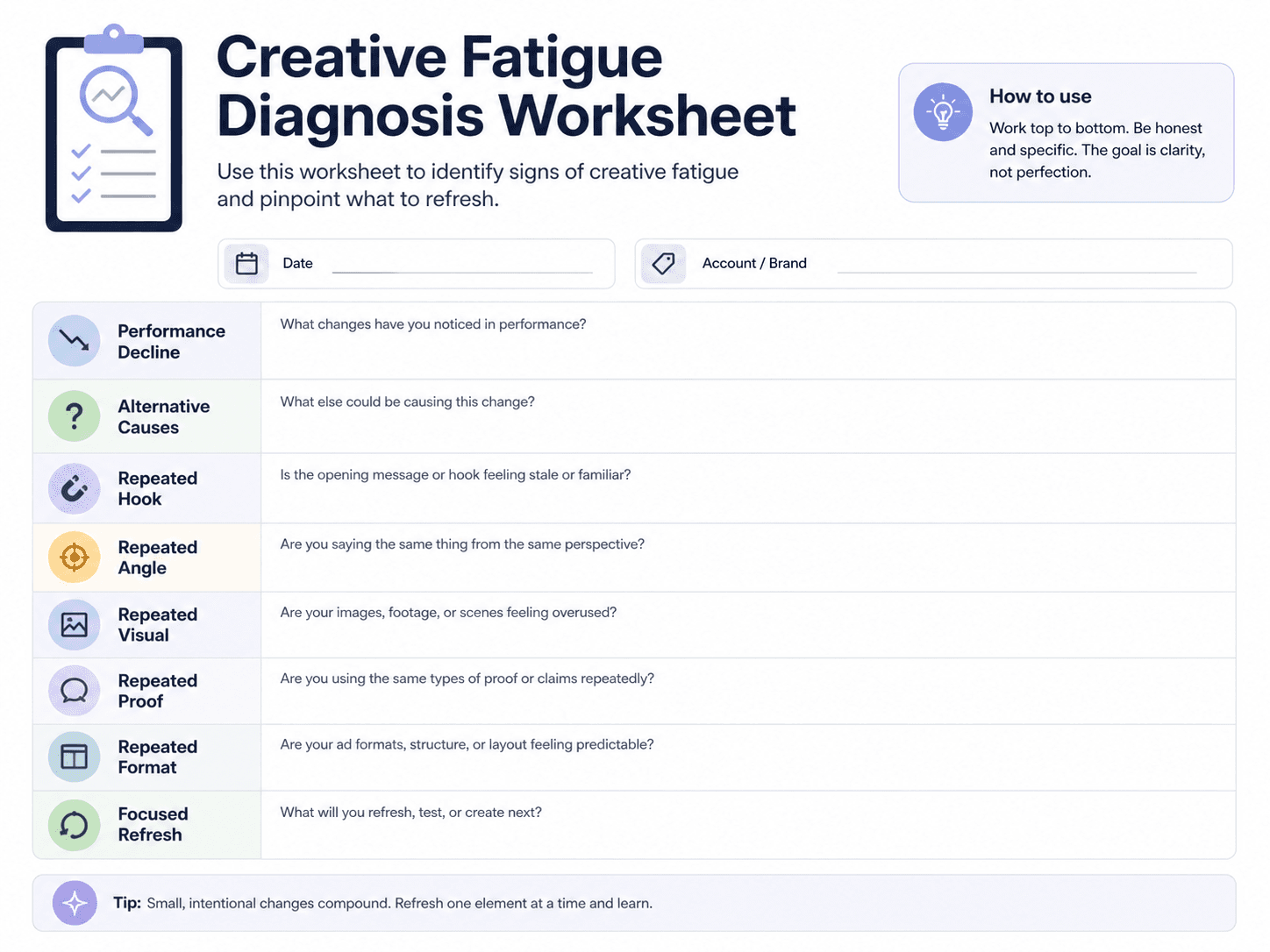
If the offer, price, timing, or customer need changed, the creative may be accurately communicating something that is no longer compelling. A new hook cannot repair every offer problem.
Distribution context can change how an otherwise familiar creative is encountered. Check whether the decline follows a placement, format, or delivery change before attributing it to fatigue.
Short windows and small samples can create a story that will not persist. Compare a reasonable period, preserve the relevant context, and avoid treating a single fluctuation as a diagnosis.
The practical rule is simple: refresh when the evidence points to a repetitive creative variable, not merely because a metric moved.
Creative fatigue is easier to act on when the team names the variable instead of saying “the ad feels tired.” Map the current creative across these dimensions:
| Variable | What repetition may look like |
|---|---|
| Hook | Every ad opens with the same claim, question, or pain point. |
| Opening visual | The same first frame, movement, layout, or product shot appears repeatedly. |
| Angle | Variations use different words but make the same argument. |
| Script | The sequence of setup, explanation, proof, and CTA never changes. |
| Proof | Every version relies on the same testimonial, demonstration, or evidence. |
| Product demonstration | The product is shown in the same context and role each time. |
| Format | The same voiceover, creator framing, duration, or edit rhythm dominates. |
| CTA | Every ad asks for the same action in the same way. |
The map does not tell you which variable to change. It helps you see what has remained constant and choose a more useful next question.
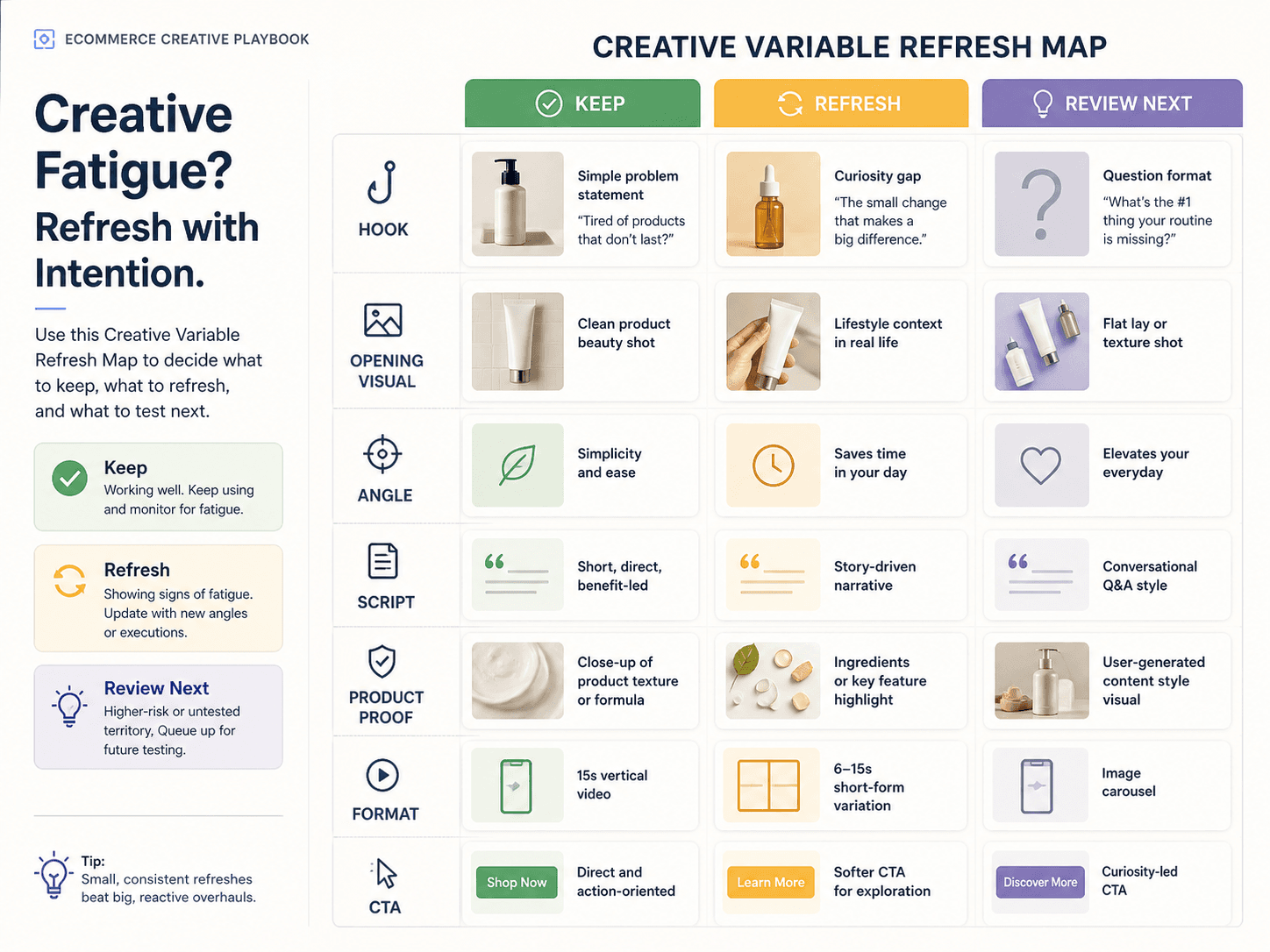
Start with the smallest meaningful change that addresses the diagnosis. If the angle is repetitive, preserve the useful product context but write a different problem or point of view. If the opening visual is repetitive, change the first moment without rewriting every downstream section. If the proof is stale, revisit the evidence rather than merely changing its typography.
Use the Next Creative Refresh Brief:
Changing one meaningful variable keeps the next decision understandable. It does not turn the work into a full testing methodology; it simply prevents a refresh from becoming an uncontrolled rewrite.
Use this sequence when the diagnosis points toward fatigue:
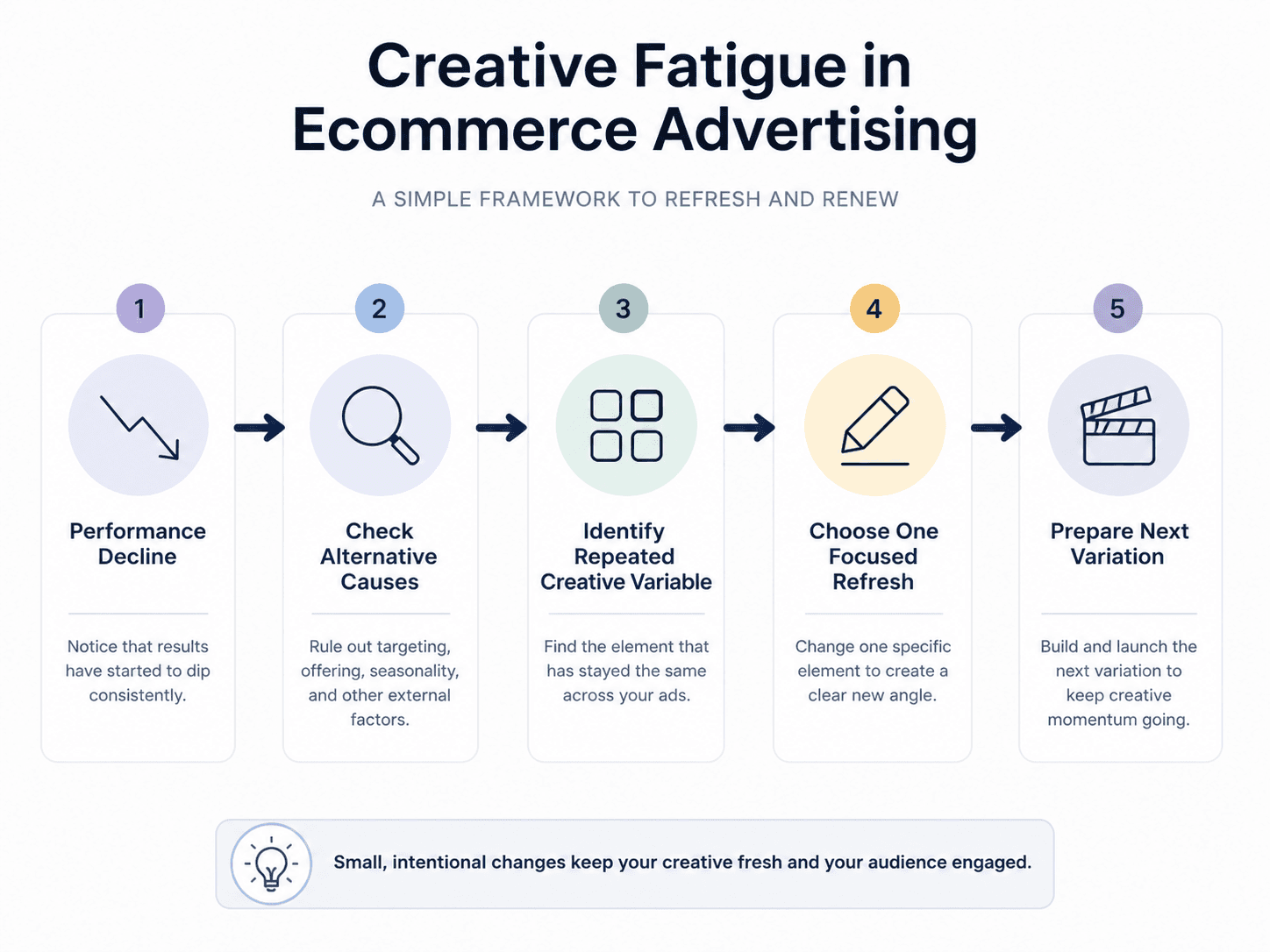
Teams often need a clear way to organize product assets, creative angles, scripts or scenes, and structured video variations while preparing that brief. A workflow layer such as Sprokl can be relevant at this point as an organizational aid for production and iteration. It should not be treated as an automatic creative-fatigue detector, campaign analyst, experiment runner, or performance guarantee.
Changing everything at once. A new hook, format, offer, audience, and CTA may produce a different ad, but it will not clarify what addressed the diagnosis.
Making more ads without a hypothesis. Volume is not a diagnosis. More variations can multiply the same repetitive angle and make review harder.
Assuming every decline is fatigue. Weak concepts, offers, delivery context, and measurement noise can look similar from a distance.
Treating prediction as evidence. A team can form a useful hypothesis about the next refresh, but it should not describe an expected outcome as a fact.
Confusing a refresh with a full testing methodology. The immediate job is to identify what should change next. Detailed variable control, experiment design, and measurement belong to a separate testing framework.
No. It makes fatigue one possible explanation. Compare the creative pattern with audience, offer, placement, delivery, and measurement context before deciding.
Usually not. Start with the variable most closely connected to the diagnosis and preserve useful context where possible.
Not always. A new hook can still lead into the same angle, proof, format, and CTA. Map the whole creative before choosing the first change.
There is no universal schedule. Refresh when the evidence and audience context support the diagnosis, not because a calendar date guarantees fatigue.
Do not assume that. A workflow can help organize assets, angles, scripts, scenes, and variations, while the diagnosis still requires human judgment and appropriate campaign evidence.
Imagine a product ad that used to receive steady attention but now produces weaker response after the same audience has seen several versions. The first pass should not be “make five new ads.” Create a short diagnosis table instead:
| Question | Observation | What it means for the next decision |
|---|---|---|
| What changed? | The opening claim and first product shot repeat across versions. | Hook and opening visual are candidates for review. |
| What else could explain it? | The offer and placement mix also changed. | Fatigue is plausible, not proven. |
| Which variable is shared? | The angle and proof point stay constant even when the edit changes. | A new edit alone may not create a meaningful refresh. |
| What should change first? | Try a different problem framing while preserving product accuracy. | The next brief can focus on one new angle. |
This example does not establish that the audience is fatigued. It establishes a better question: does the repeated angle explain why the current creative feels interchangeable, and is there enough context to justify a focused refresh? If the offer or delivery context changed at the same time, the team may need to resolve that issue before treating the creative as the primary cause.
A useful brief is specific enough for another person to review before production. Include the original creative pattern, the reason it is being reconsidered, the variable that will change, and the parts that should remain stable. Write the new direction in observable terms: “open with the customer problem before showing the product” is more useful than “make it fresher.” Name the audience context, the proof or demonstration that remains accurate, and the question the team will revisit after the next cycle.
The brief should also record what it does not claim. It does not promise that a new angle will win, prove that fatigue caused the decline, or replace campaign and audience evidence. It gives the production team a traceable reason for the next change. That keeps the diagnosis framework separate from a full testing plan and prevents a refresh from being mistaken for automatic optimization.
Creative fatigue is a diagnosis problem before it is a production-volume problem. Start by separating a real repetition pattern from other causes of decline. Then identify which creative variable has become repetitive, choose one focused change, and write a refresh brief that the team can review clearly.
The best next creative cycle is not necessarily the one with the most new ads. It is the one where the team can explain what changed, why it changed, and what it learned from the decision.
Keep exploring


Make the next creative move
Build, test, and iterate on ecommerce ad creatives faster with AI-powered concepts, scripts, and variations.