
AI Advertising·Aug 17, 2026
Learn how ecommerce brands can build a repeatable creative testing framework to produce better variations, measure results, and scale useful learnings.
By Sprokl Team · Updated August 17, 2026
Ecommerce teams rarely struggle because they have no ideas. More often, they struggle to turn existing product assets into enough meaningful variations to learn from. When every new ad is produced as a one-off, performance changes are difficult to explain and the next creative decision becomes guesswork.
This guide explains a practical creative testing framework for ecommerce brands. The goal is not to produce ads randomly or promise a shortcut to winning creative. It is to build a repeatable workflow for forming hypotheses, creating useful variations, measuring outcomes, and carrying learnings into the next iteration.
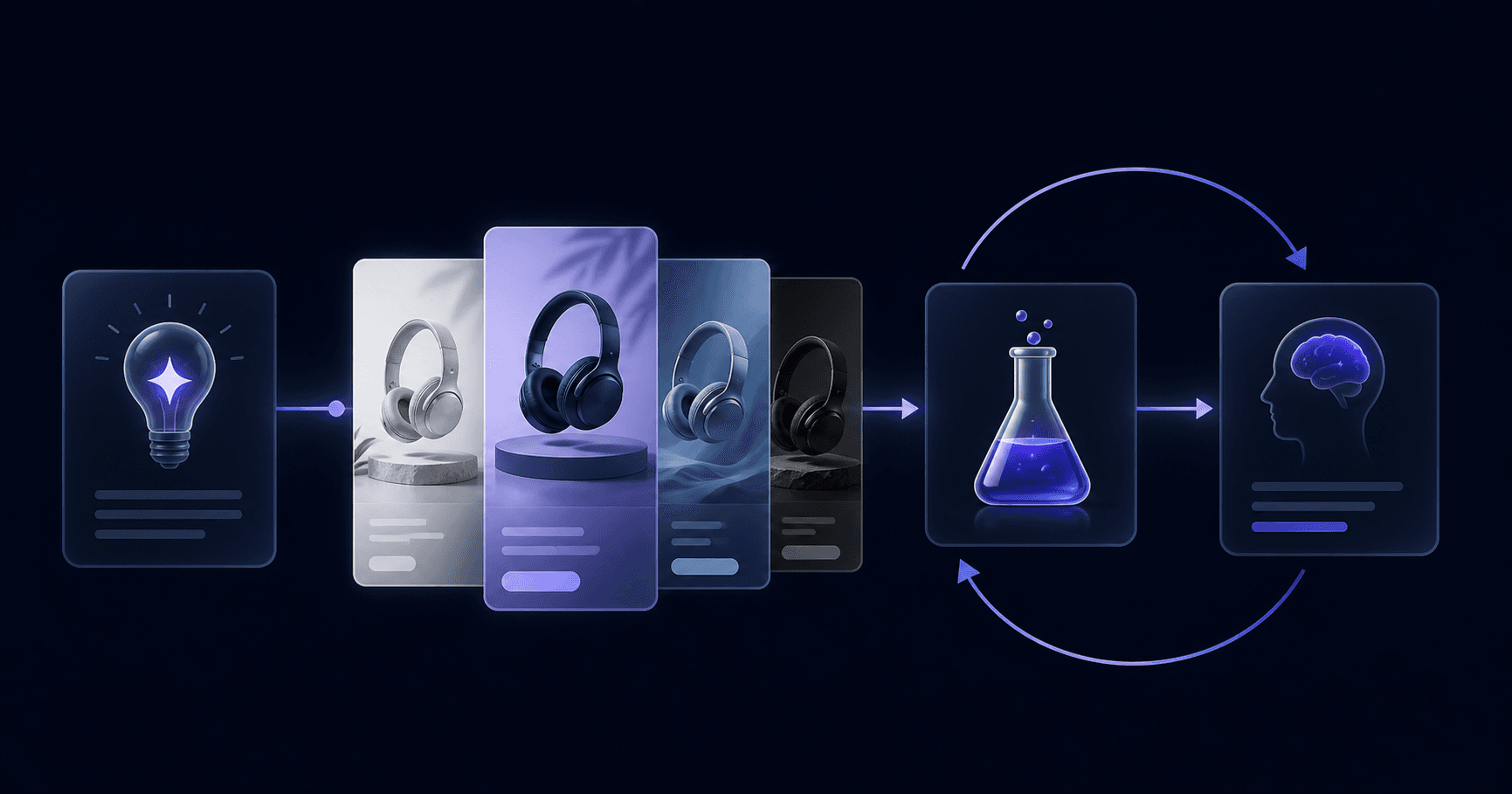
Creative performance can change when the hook, visual, offer, product demonstration, format, or call to action changes. If several of those elements change at once, a team may see a different result without knowing what caused it.
That uncertainty creates two expensive habits: teams keep repeating ads that have stopped teaching them anything, or they abandon promising ideas before they have tested a clear variation. A structured testing workflow makes the learning process visible. It gives a team a way to compare creative decisions and decide what to make next.
The important output of a test is not only a higher or lower metric. It is a clearer understanding of which message, visual idea, or format is worth exploring further.
What should I do next? Turn one unclear creative difference into one testable question.
A creative testing framework is a documented method for turning creative ideas into controlled experiments. It defines the question being tested, the variations that represent different answers, the measurement window, and the decision that will follow the result.
This is different from launching many unrelated ads at the same time. A useful test changes a meaningful variable while keeping enough context stable to make the comparison useful. The exact design depends on the channel, audience, budget, and campaign objective, but the reasoning should always be explicit.
The framework should also record what was learned. Without documentation, a team may recreate the same experiment months later or mistake a temporary result for a durable creative principle.
What should I do next? Write down one changed variable and one held-constant context before creating variations.
Start with a statement that can be supported or challenged. For example: “A short product demonstration in the first three seconds will make the value of this product clearer to new shoppers.” The hypothesis connects a creative change to a user response.
Avoid vague goals such as “make the ad better.” Define the audience, the creative variable, the expected behavior, and the metric that will help evaluate it.
Build variations around the hypothesis rather than changing everything at once. A team might keep the product, offer, and audience consistent while testing different hooks. In another experiment, the hook can stay stable while the team compares a demonstration, testimonial, and before-and-after visual.
This is where production efficiency matters. Existing product assets can often be recombined into new openings, sequences, captions, crops, and formats. More variations are useful only when each one represents a reasoned creative idea.
Choose a suitable audience, placement, budget, and testing duration before the experiment begins. Keep the comparison fair enough that the result is interpretable, and avoid ending a test simply because an early signal feels exciting or disappointing.
The right setup varies by campaign. A controlled experiment does not mean every brand uses the same statistical method. It means the team knows what is being compared and what conditions could make the result unreliable.
Review more than the top-line result. Look at the relationship between hooks, visuals, formats, calls to action, and downstream behavior. A useful analysis asks which creative elements appeared in strong performers and whether the pattern is consistent across enough context to justify another test.
This is also the moment to identify declining ads. A declining result is not automatically a failure; it may reveal that the message needs a new opening, a different proof point, or a refreshed set of variations.
Turn the result into a next action. Scale a useful creative principle into new variations, audiences, or placements while keeping the original learning visible. Do not treat one result as a universal rule for every product.
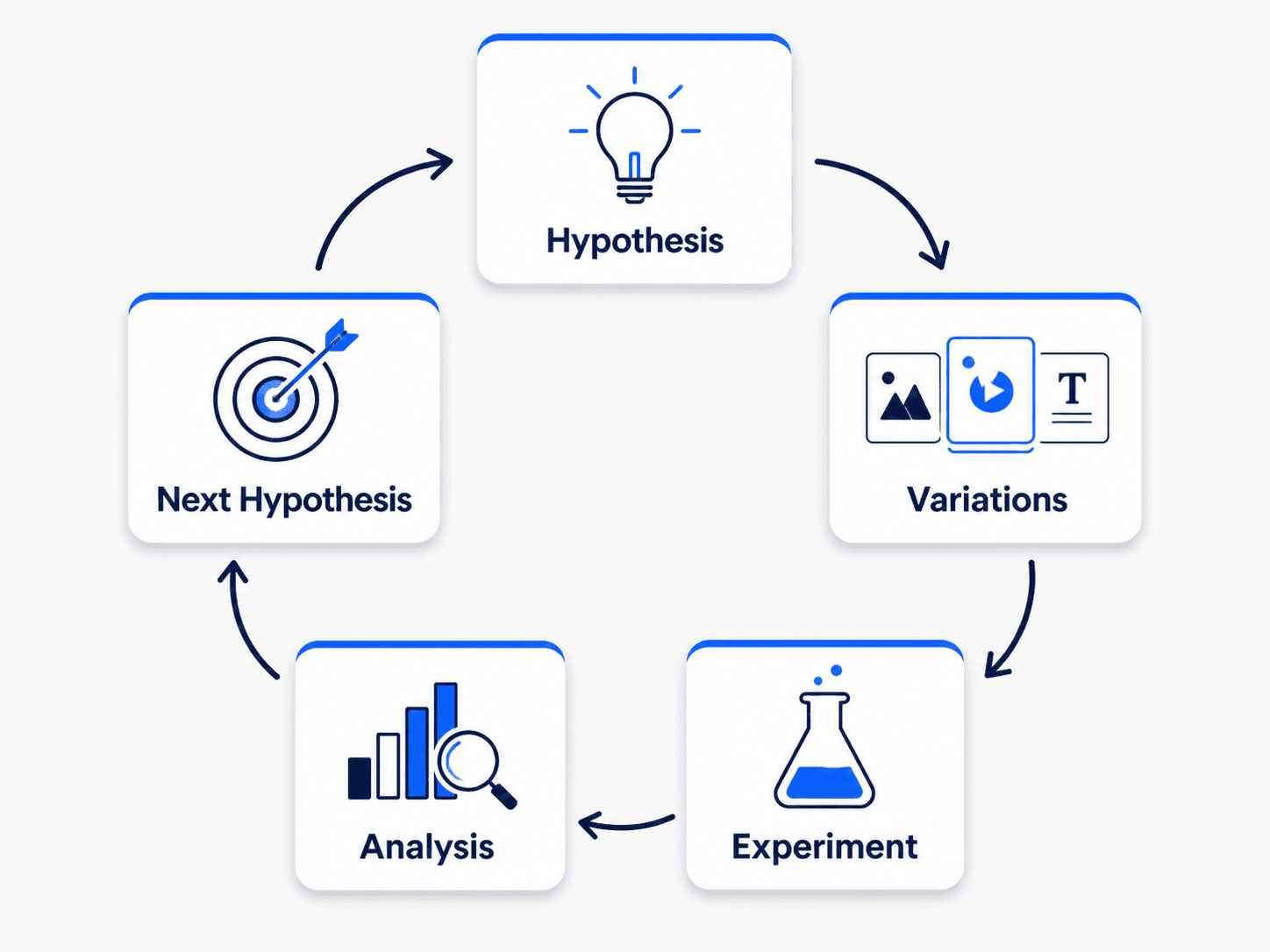
The best testing systems create a loop: hypothesis, variation, experiment, analysis, and the next hypothesis. Over time, that loop becomes a practical creative knowledge base for the team.
What should I do next? End every test with an observation and a next hypothesis.
AI can help teams increase the speed of creative iteration, but speed alone does not create better learning. The quality of the inputs still matters: product assets, customer language, message hypotheses, brand constraints, and a clear testing question.
AI is most useful when it helps a team explore structured variation. It can support different hooks, scenes, scripts, crops, or product demonstrations while the team decides which ideas deserve a real test. Human review remains important for accuracy, brand voice, claims, and context.
Sprokl can help teams turn existing product assets into more structured creative variations for testing. Its role is to support the production workflow, not to decide whether an experiment is valid or run the experiment automatically.
Sprokl fits into the production side of this workflow. Teams can use it to organize product assets and creative inputs, develop structured variations, and prepare ideas for testing. For example, creative angles can help shape the questions behind a variation, while AI ad scripts can help plan the messaging and scenes that express it. The value is a clearer path from one product asset to several intentional variations.
Sprokl is not a replacement for experiment design, media buying, attribution, or measurement. It does not automatically run experiments, guarantee a winning ad, or promise a specific return. It helps reduce the production friction that can prevent teams from preparing enough meaningful creative ideas for a real test.
What should I do next? Prepare structured creative variations before handing them into a real campaign or testing workflow.
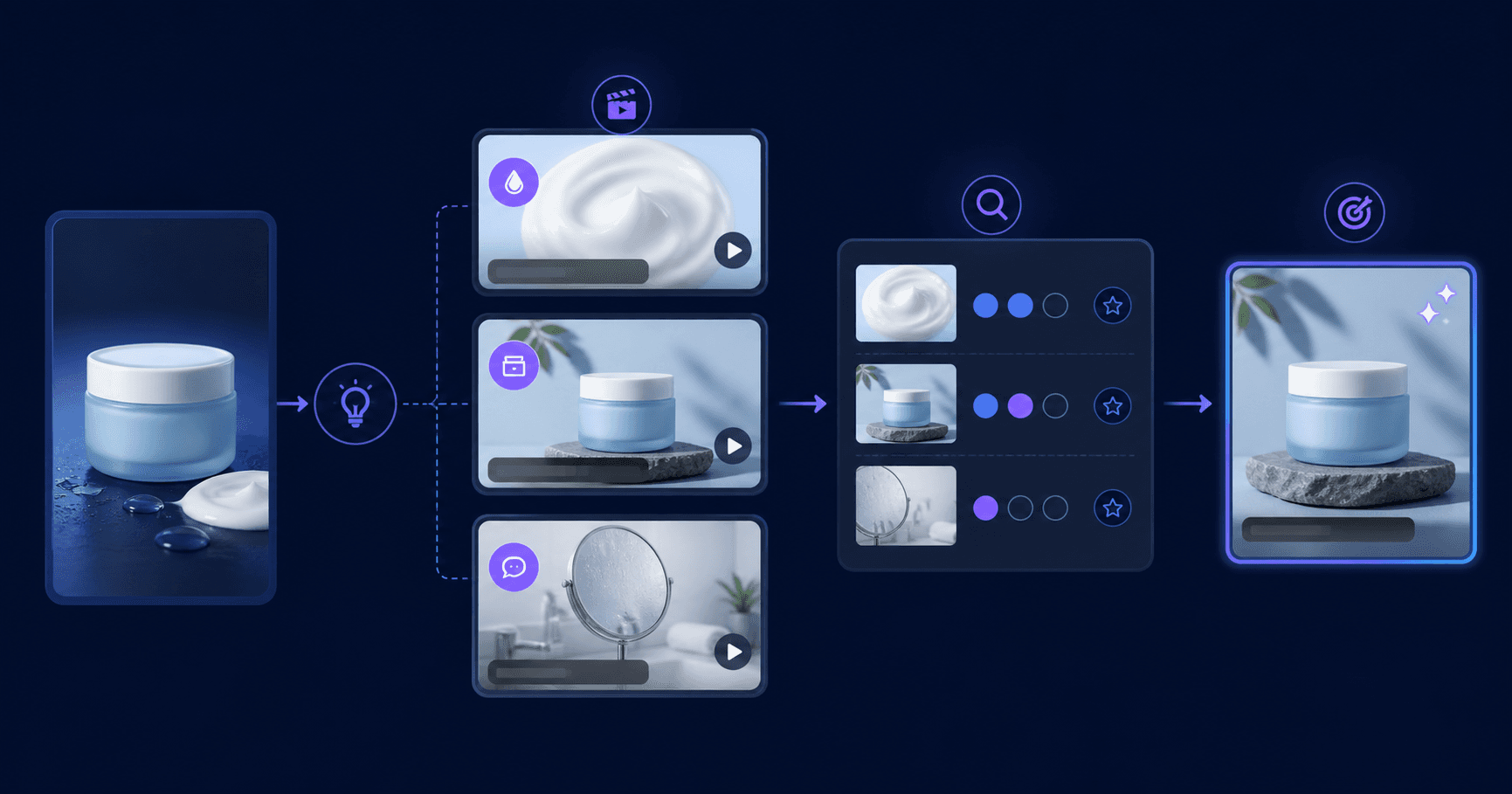
Hypothetical example. Imagine an ecommerce brand launching a new lightweight moisturizer. The team has a product texture demonstration video, a static product shot, customer review language, and product-description copy, but it does not know which opening will make the product experience clear to first-time shoppers.
The team defines the creative angle as texture and product-experience clarity. Its hypothesis is: “If the first three seconds show the moisturizer texture clearly, first-time shoppers may understand the product benefit faster than when the ad opens on a static product shot.” This is a question to investigate, not a guaranteed outcome.
The variable changed is the opening visual / first-three-second creative. The product, offer, audience, landing page, and primary campaign objective stay constant so that the comparison remains interpretable.
| Variation | Creative angle / hook | Variable changed | Variables held constant | Evidence to inspect | Next creative decision |
|---|---|---|---|---|---|
| Texture demonstration opening | Texture / show the product experience before the packaging | First-three-second opening visual | Product, offer, audience, landing page, primary campaign objective | Creative-level engagement quality, message clarity, downstream behavior | If the learning is clearer, develop more texture-led openings |
| Static product shot opening | Product recognition / show the package first | First-three-second opening visual | Product, offer, audience, landing page, primary campaign objective | Whether the comparison remains interpretable and the product promise is understood | Keep as a reference variation or test a different product-led hook |
| Customer-problem opening | Problem framing / start with the shopper's skincare concern | First-three-second opening message and visual | Product, offer, audience, landing page, primary campaign objective | Whether the problem framing clarifies the reason to care | If evidence is useful, test narrower problem-specific hooks |
| Testimonial-style opening | Customer proof / lead with review language | First-three-second opening message and visual | Product, offer, audience, landing page, primary campaign objective | Whether customer language improves message clarity | Develop more proof-led variations only if the result supports another question |
The team should only record what the real test actually shows. It should inspect whether the differences are interpretable, document the observation, and avoid filling the example with invented CTR, ROAS, conversion rate, revenue, or customer counts. If the texture-led direction produces clearer learning, the next decision is to refine that direction; if the evidence is ambiguous, the team should narrow the variable or revise the hypothesis. One result should not become a universal rule for every product.
What should I do next? Compare one primary creative variable at a time, then turn the observation into the next creative decision.
Teams using video variations can apply the same principle when turning one product workflow into several testable video directions.
Creative testing tools are useful when they reduce the friction between an idea and a comparable experiment. Look for workflows that help teams organize product assets, generate structured variations, label hypotheses, compare creative elements, and preserve learnings for the next iteration. For ecommerce teams, a relevant ecommerce ads workflow may be more useful than a broad feature list. A tool should support the testing system; it should not replace experiment design or measurement.
There is no universal duration. Set the testing window before launch and use enough time and signal for the campaign objective, audience, budget, and channel. Avoid ending a test only because an early result looks exciting or disappointing.
Change a meaningful variable that answers the hypothesis while keeping enough context stable for comparison. If the hook, visual, offer, audience, and format all change together, the team may not know what caused the result.
Document the result, identify which creative elements may have contributed, and turn the learning into the next hypothesis. Scale a useful principle into new variations instead of treating one result as a universal rule.
A practical creative testing framework gives ecommerce teams a shared way to make creative decisions. Define a hypothesis, create focused variations, run a fair experiment, analyze the elements behind the result, and carry the learning into the next iteration.
The most durable advantage is not producing the largest number of ads. It is building a system that turns existing product assets into better questions, clearer experiments, and useful creative learning.
Related coverage: creative testing, ad creative testing.
This framework is informed by Meta's guidance on ad creative strategy, AdSights' rigorous creative testing framework, Motion's creative testing workflow, and AppsFlyer's creative optimization case study. These sources support the sections on creative variation, controlled testing, winning-creative analysis, and measurement.
Keep exploring
Make the next creative move
Build, test, and iterate on ecommerce ad creatives faster with AI-powered concepts, scripts, and variations.