
Ecommerce Marketing·Oct 2, 2026
Compare static vs dynamic ads for ecommerce: when to use each format, production tradeoffs, and practical creative tests for Shopify brands.
By Sprokl Team
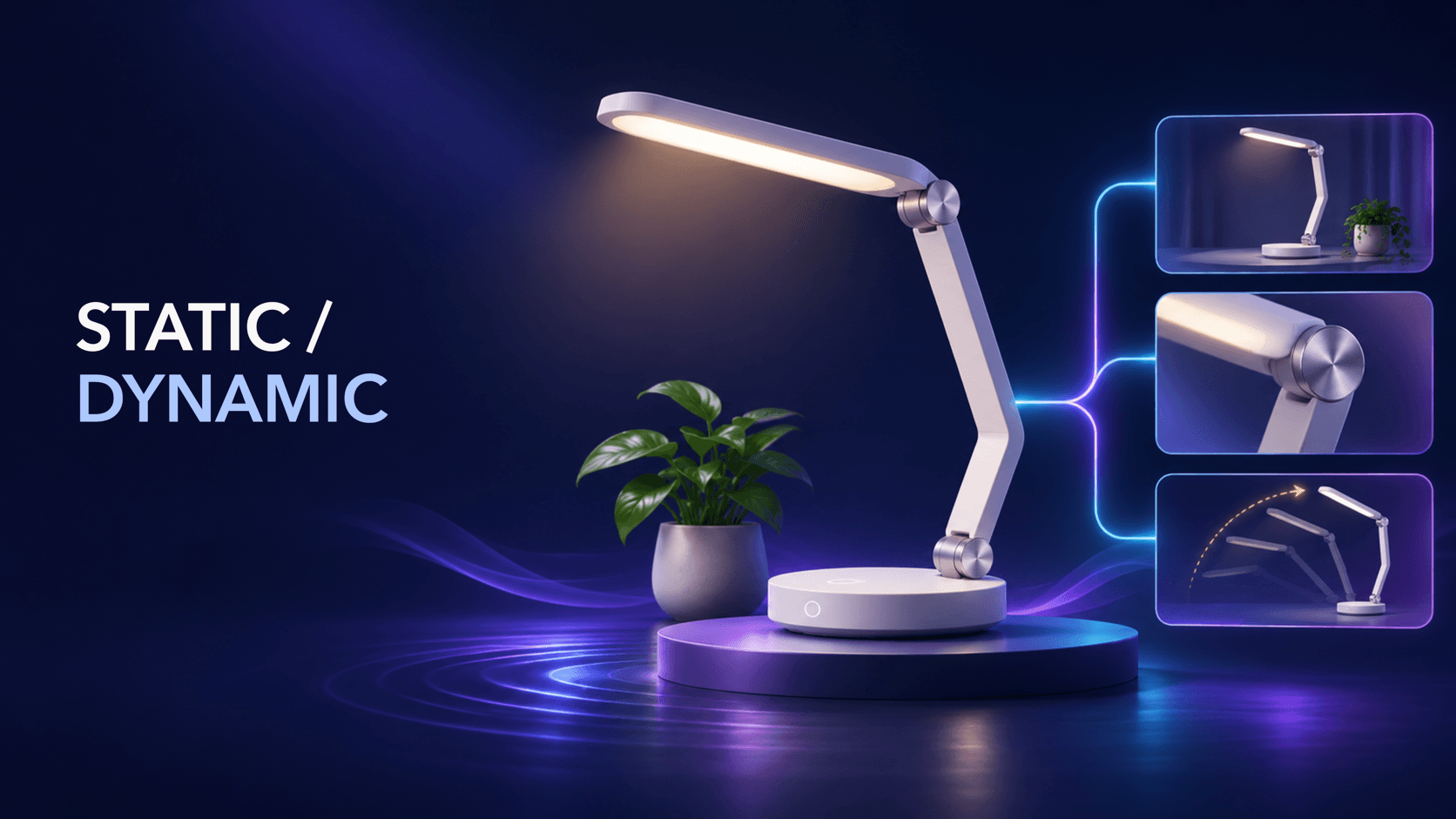
When ecommerce teams compare static vs dynamic ads, the useful question is not which format is universally better. It is which format makes the product, problem, proof, or next step easiest to understand for this audience and placement.
A static ad can communicate one sharp idea in a single frame. A dynamic ad can use motion, sequence, demonstration, or multiple creative inputs to explain something that would be difficult to show at once. Both can be valuable. The right choice depends on the buyer question, the available product assets, and what the team wants to learn.
This guide compares the two formats for Shopify and ecommerce creative teams. It focuses on format decisions and testable creative variations—not bidding, targeting, campaign setup, or catalog-based dynamic product ads.
A static ad is a single image or graphic-led creative treatment. It may show a product, a use case, a customer proof point, a comparison, an offer, or a concise message. “Static” describes the creative experience, not the quality or simplicity of the idea.
Static ads work best when the viewer can understand the main point without watching a sequence. Examples include:
Shopify treats images as a core product-media type and notes that consistent aspect ratios help product images display more consistently side by side. That is useful context for production: a clean static system should keep the product recognizable across crops and placements, while preserving enough space for the message.
Static does not mean “make one image and stop.” A team can create a family of static variations by changing one meaningful variable at a time: the opening headline, product crop, proof treatment, background, benefit emphasis, or CTA.
A dynamic ad uses motion or a sequence to communicate the idea. In this article, dynamic refers to video or motion-led creative—not the separate technical category of catalog or automated product ads.
Dynamic creative can show:
Shopify supports product videos alongside images and other media, but that does not make video the right choice for every advertising message. The extra dimension is valuable when motion answers a question that a single frame cannot answer clearly.
Dynamic creative also creates more production decisions: opening frame, shot order, pacing, captions, sound assumptions, product visibility, transitions, and CTA timing. More expressive does not automatically mean more persuasive. It means the team has another way to communicate and another set of variables to review.
| Decision factor | Static creative | Dynamic creative |
|---|---|---|
| Best communication job | One message, proof point, offer, or comparison | Demonstration, sequence, use case, or multi-step explanation |
| Production speed | Usually faster to brief, make, and version | Requires scripting, shot planning, editing, and format QA |
| Product clarity | Strong when the product is recognizable in one frame | Strong when movement or context explains the product |
| Versioning | Easy to vary copy, crop, background, or proof | Easy to vary hook, scene order, voiceover, captions, or ending once a system exists |
| Main risk | Too much copy or a product that is hard to identify | Slow opening, late proof, unclear audio, or visual overload |
| Useful review question | Can the viewer understand the point immediately? | Does the sequence earn attention and deliver the promised proof? |
The distinction is a planning tool, not a ranking. A well-made static ad can be more useful than a rushed video, and a short demonstration can be more informative than a crowded product graphic.
Choose a static direction when the creative job is narrow and visual. Static is often a good starting point when:
If the main benefit can be communicated with the product, one supporting detail, and a short line of copy, a single frame may reduce friction. A storage product can show its capacity with a clear arrangement. A skincare device can show the device and a specific routine context without implying unsupported results.
Static systems are useful for exploring angles before investing in a full shoot. Keep the product and offer stable, then test a fit message against a convenience message, or a product detail against an attributed review. This creates a clearer learning question than changing the whole ad at once.
Ratings, dimensions, ingredient callouts, product details, and a clearly attributed customer quote may be easier to review in a composed frame. The team still needs to verify the claim and keep text legible at the intended size.
Static creative can make more disciplined use of existing product images when there is not yet enough footage for a strong sequence. That is not a reason to add decorative text or unsupported claims. It is a reason to choose a message the available asset can actually support.
Choose a dynamic direction when motion or order carries meaning. Dynamic is often a good fit when:
Opening a package, connecting a part, adjusting a feature, or using a product in a real context can answer a practical question faster than a paragraph. The first seconds should orient the viewer: show the product or the problem early, then earn the time needed for the proof.
Some ideas need a beginning, middle, and end: problem, product action, and result; setup, use, and cleanup; or question, demonstration, and CTA. A dynamic treatment gives each step room without forcing every detail into one frame.
Video can show a product moving between contexts, but do not turn a list of features into a rushed montage. Pick a buyer question and let the sequence answer it. The product video advertising guide covers the broader production planning layer.
Creator-like demonstrations, voiceover, or a hand interacting with the product can make a use case concrete. They still require rights, accurate claims, and review. A dynamic format is not permission to imply a customer experience that did not occur.
Use the buyer question as the deciding input:
For a product with a broad catalog, do not confuse this creative-format decision with automated product-feed assembly. The article is about how the ad communicates, not how a platform selects products for delivery.
The cleanest comparison changes one important creative variable while keeping the communication job stable. Meta’s Audience Network testing guidance illustrates the general principle: define the variable, create comparable versions, and avoid changing everything at once. Its examples are placement-specific, so use the principle carefully rather than treating the guidance as proof that one format wins.
Try one of these test designs:
Before launch, define the learning question and the review fields: format, angle, hook, product moment, proof, duration, placement, CTA, and the claim or assumption being tested. After launch, keep the measurement definition and denominator visible. A difference in response can reflect audience, offer, placement, landing page, or delivery—not only the file type.
For a broader way to structure live creative comparisons, use the creative testing framework as a companion—not as a reason to change several format variables at once.
Write the question in plain language: “Will this organizer fit my drawer?” is more useful than “Show the product.” This prevents format from becoming the strategy.
The product messaging guide is useful when the team has not yet separated the audience problem, benefit, differentiation, and proof that the creative needs to communicate.
Build a static mockup, a short shot list, or a rough script before polishing. The draft should show the product, message, proof, and CTA well enough for another person to review.
List what will stay fixed and what will change. For example, keep the product, offer, and proof fixed while changing the hook; or keep the hook fixed while comparing a static product card with a product-use sequence.
Check crops, safe areas, captions, sound-off comprehension, product visibility, CTA destination, permissions, and claim support. Shopify’s product-media guidance is a useful reminder that media requirements and display behavior vary by type and theme; paid placements add their own constraints.
The output of the test should be a better production decision, not a universal rule. Record what the team learned and what the next variation will isolate.
Sprokl helps ecommerce teams develop creative angles, turn approved directions into AI ad scripts, and create video-ad concepts and variations from product assets and brand information. That makes it useful when a team wants to turn one buyer question into several structured static or dynamic directions for review.
Sprokl does not guarantee a winning format, performance, conversions, or revenue. It does not replace product, brand, claims, legal, or creative judgment, and generated output still needs review before production or publication.
Use static ads when one frame can make the product, benefit, proof, or offer immediately clear. Use dynamic ads when the buyer needs to see action, sequence, context, or multiple moments. When the answer is uncertain, create a matched static and dynamic pair around the same buyer question and test the smallest meaningful difference.
The goal is not to crown a permanent winner. It is to build a repeatable creative system that makes the next ecommerce ad easier to understand, produce, review, and improve.
Keep exploring
Make the next creative move
Build, test, and iterate on ecommerce ad creatives faster with AI-powered concepts, scripts, and variations.