
Ecommerce Marketing·Sep 21, 2026
Learn how ecommerce advertising connects audience context, creative formats, product proof, calls to action, and meaningful ad variations.
By Sprokl Team

Ecommerce advertising is paid promotion for products or online stores across channels such as search, social, display, video, and shopping surfaces. It sits inside ecommerce marketing, but it has a more specific job: connect a paid impression to a useful product message and a clear next step.
The media placement matters, but the ad still has to help someone understand the product. A practical ecommerce advertising workflow therefore starts with the audience and the buyer’s question, then chooses a message, format, product proof, and call to action. The goal is not to promise a winning ad. It is to produce a clear, reviewable set of creative decisions that a team can learn from.
This guide focuses on creative execution and production. It does not cover bidding, campaign configuration, or targeting tutorials. Shopify describes ecommerce advertising as paid promotion through digital channels and distinguishes it from the broader practice of ecommerce marketing. (Shopify)
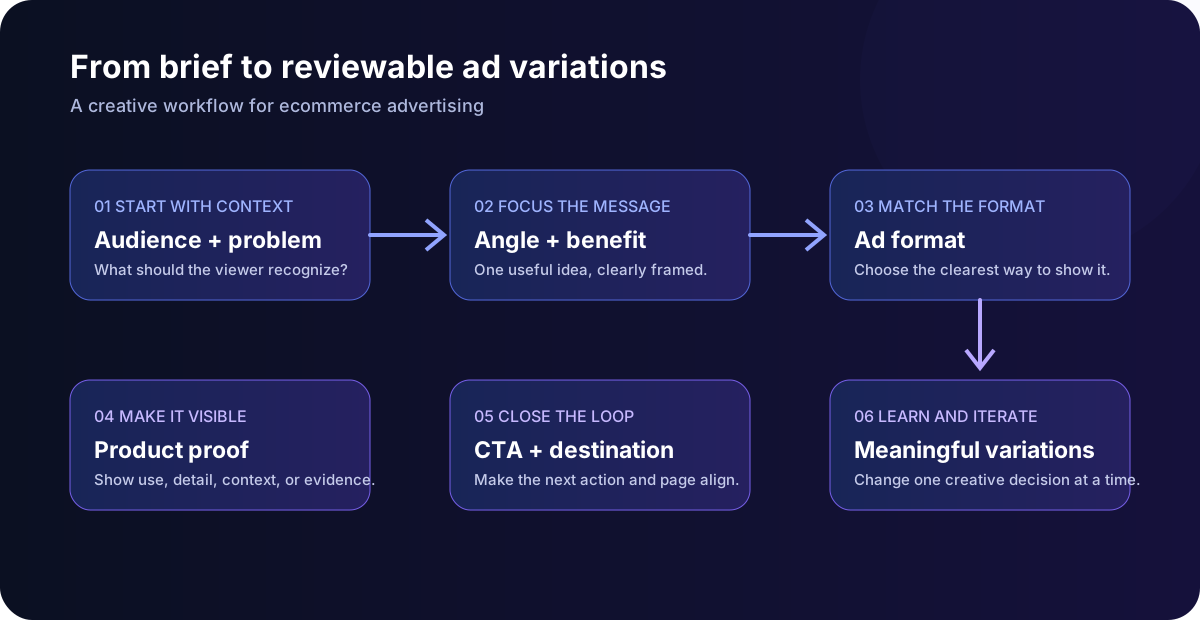
Before choosing a platform or format, answer five questions:
For example, a generic skincare product could be framed around a morning routine, texture and application, ingredient education, or a gift occasion. Those are different creative directions. They should not be collapsed into one crowded ad simply because the product has many possible benefits.
The right format is the one that makes the message easiest to understand in its placement.
Search ads and product listings are useful when the shopper is already expressing intent. The creative job is clarity: product name, relevant description, price or offer when applicable, and a destination that reflects the same information. Avoid writing a headline that promises one thing and sending the click to a page about another.
A static image can work when a product detail, comparison, offer, or visual idea is understandable in one frame. Use a strong focal point, short supporting text, and a visible product. The design should still work when a viewer sees it briefly on a small screen.
Short-form video gives the team room to show a problem, action, product detail, and outcome in sequence. TikTok for Business recommends earning attention quickly, showing the product in use, and supporting comprehension with captions or on-screen text. Treat those as platform guidance rather than a guarantee for every ecommerce video ad. (TikTok for Business)
A simple structure is hook → body → close. The hook makes the situation recognizable, the body shows the product and the focused message, and the close makes the next action explicit. TikTok’s Creative Codes also documents this structure for TikTok creative. (TikTok Creative Codes)
Creator-style creative can make a product feel easier to understand when the person demonstrates a real use case, explains an objection, or walks through a decision. “Authentic” should not mean inventing a testimonial or claim. Keep the script grounded in approved product information and review the final cut for accuracy, disclosure, captions, and brand fit.
An ad shown to someone who already visited a product page may have a different job from a prospecting ad. It can clarify a product detail, answer a common question, remind the viewer of the use case, or point back to the relevant page. Do not assume that prior exposure removes the need for context; the creative still needs to be understandable when viewed on its own.
An ecommerce advertising brief can be short:
The message should survive compression. If the viewer remembers only one sentence, what should it be? That sentence becomes the filter for the hook, footage, copy, captions, and CTA.
The examples below are hypothetical. They demonstrate creative patterns, not expected performance.
Open with a recognizable situation: a crowded desk, a hard-to-pack item, or a product choice that feels confusing. Then show the product addressing that situation. The proof should be visible and specific, while the close points to the product page or a relevant guide.
This pattern is useful when the audience already knows the problem but may not know which product approach to consider.
Start with the product action: opening, applying, assembling, carrying, comparing, or using it in context. Keep the sequence easy to follow. Add only the product details that help explain what the viewer just saw.
This pattern is useful when the product’s value is easier to understand through motion than through a list of features.
Choose one reasonable question such as “How does it fit into a small space?” or “What does the setup look like?” Answer it with an approved detail, comparison, close-up, or demonstration. Do not turn an unanswered question into an unsupported claim.
This pattern is useful when a shopper needs more confidence before clicking through.
One brief can produce several ecommerce ad variations without creating random edits. Change a deliberate creative decision:
| Variation | What changes | What stays consistent |
|---|---|---|
| Problem-led | Opening situation and first line | Product, core message, destination |
| Demonstration-led | First product action and shot order | Approved product details and CTA |
| Proof-led | Supporting evidence or objection | Audience context and main promise |
These are production variations, not proof that one version will outperform another. Label each version by its hypothesis, keep the product truth consistent, and record what the next review should investigate. For a deeper treatment of hypotheses and comparisons, see the creative testing framework.
Use a practical quality check:
The landing page is part of the experience. If the ad highlights a product, color, offer, or use case, the destination should make that same context easy to find. A clear ad cannot repair a mismatch after the click.
Sprokl fits on the creative-production side of this workflow. Teams can use it to explore creative angles, generate ad scripts, and create video variations from product assets and brand information. The relevant output is a more structured set of concepts and drafts—not an automatic campaign manager or a guarantee of performance.
Product, brand, claims, legal, and final creative review remain human responsibilities. A team can then take the approved direction into its existing ecommerce ads workflow, with the right measurement and campaign decisions handled in the advertising platform.
Ecommerce advertising is paid promotion for online products or stores across digital channels such as search, shopping, social, display, and video. It is one part of ecommerce marketing.
Start with a relevant audience situation, communicate one clear product message, show useful proof, and make the next action easy to understand. No single creative pattern guarantees a result across products, audiences, placements, or campaigns.
Create enough variations to represent distinct creative hypotheses while keeping review manageable. Two or three meaningful directions are often more informative than many near-identical edits, but the right number depends on the asset set, placement, and review capacity.
AI can help generate angles, scripts, and variations, but it should not replace product, brand, claims, legal, or creative review. Check every output against the actual product and approved information.
Ecommerce advertising becomes easier to manage when the team treats each ad as a chain of decisions: audience context, problem, message, format, product proof, CTA, and reviewable variation. Start with the buyer’s question, show what the product actually does, match the destination page, and use iteration to decide what the next creative brief should explore.
When a team needs help moving from product assets to structured directions, scripts, and video variations, Sprokl can support the production workflow while the team keeps ownership of accuracy, claims, and final decisions.
Keep exploring


Make the next creative move
Build, test, and iterate on ecommerce ad creatives faster with AI-powered concepts, scripts, and variations.