
Ecommerce Marketing·Sep 9, 2026
Learn how to create a product advertisement that connects a buyer situation to visible proof and one clear next step—with practical patterns, examples, and a review checklist.
By Sprokl Team

A product advertisement should make one useful idea easier to understand: what the product is, why it matters in a particular situation, and what a shopper can do next. That sounds simple, but it is easy for a product ad to become a list of features, a vague lifestyle image, or a broad promise nobody can verify.
A better approach starts with a buyer question and makes the answer visible. Whether the final creative is a static image, a carousel, or a short video, the team needs a clear message, accurate proof, and a destination that matches the ad.
This guide explains a practical framework for planning product advertisements, six adaptable creative patterns, and a review checklist for ecommerce teams. The examples are fictional and illustrative; they are not performance promises.
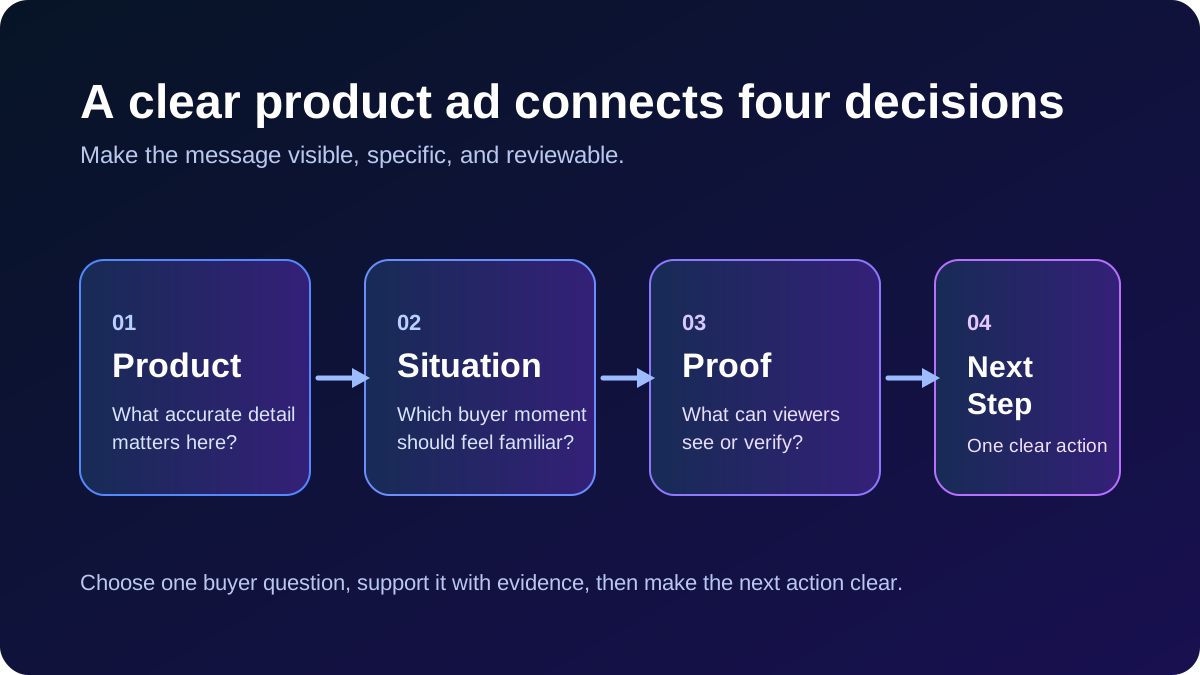
A product advertisement is creative that introduces or explains a product in a way that helps a defined audience understand its relevance. It can show a product in use, answer a question, demonstrate a feature, compare two visible states, or invite a shopper to inspect more detail.
The product itself is not the whole message. A useful ad connects four decisions:
This is different from claiming that an ad will produce a particular result. Creative quality still depends on the product, offer, audience, placement, landing page, campaign setup, and review process. The goal at this stage is clarity: make the message concrete enough to produce and evaluate.
Choose one product action, feature, configuration, or use case. “Everything about our product” is not a creative direction. A detail is useful only when a viewer can connect it to a job, concern, or outcome they understand.
For example, an insulated bottle could be shown with a lockable lid in a commuter's bag. The point is not to call it “premium.” The point is to show the detail and let the ad explain why that detail may matter during a commute.
The situation gives the product a reason to appear. It might be a repeated frustration, a question before purchase, or a moment in a routine. Make it specific enough to picture.
Weak: “Upgrade your everyday.”
More useful: “Need a bottle that can move from your desk to a crowded bag?”
The second line does not guarantee that the product solves every commuting problem. It gives the creative team a setting, a viewer question, and a way to decide which product evidence belongs in the ad.
Proof can be a demonstration, an approved specification, a clear product detail, a real permissioned customer statement, or a comparison whose conditions are shown honestly. It should support the message rather than decorate it.
If an ad says a container nests together, show the nesting action. If it refers to a stated dimension, use the approved measurement. If the proof is a customer quote, confirm that it is real, approved, and presented in context. Avoid replacing evidence with labels such as “best,” “revolutionary,” or “guaranteed.”
The call to action should match the viewer's stage and the destination. A shopper who has just seen a new mechanism may need “See how it works.” A shopper comparing options may need “View sizes.” One clear action is easier to understand than a pile of competing instructions.
Google's video-ad ABCD guidance provides a useful reference for this logic: Attention, Branding, Connection, and Direction. It recommends getting into the story quickly, making the product or brand recognizable, focusing the message, and adding a clear CTA. Treat those principles as guidance to adapt to the objective and placement, not as a formula or a guarantee. (Google Ads Help: About the ABCDs of effective video ads)
The pattern is a communication choice, not a prediction about what will perform best. Select one because it answers the buyer question your available evidence can support.
Buyer question: “How does it work?”
Show the relevant action in a clear sequence. A coffee grinder can be shown opening, receiving beans, and dispensing grounds into a container. Keep the camera close enough that the mechanism is understandable. A demonstration is strongest when it shows the exact action behind the message instead of relying on an abstract slogan.
For a fuller video-production workflow after the creative idea is settled, see Product Video Advertising.
Buyer question: “Can this help with the friction I have?”
Open with a familiar problem, then introduce one product action that addresses it. For a fictional cable organizer, the creative might begin with a desk drawer full of tangled charging cords, then show the organizer separating and labeling each cable. The resolution should be visible and proportionate; do not turn one tidy drawer into a universal productivity claim.
Buyer question: “Why does this detail matter?”
Choose one feature and place it in the moment where it is useful. A jacket's zip pocket matters more when a runner can see it hold a key on an evening route. The feature is not a catalog bullet; it is evidence in context.
Buyer question: “What changes when I use it?”
Compare two visible states only when the conditions are fair and easy to understand. A screen protector can be shown before and after an installation step using the same device, lighting, and camera distance. Do not imply results beyond what the comparison shows, and never use a selective comparison to invent a product claim.
Buyer question: “What might stop me from considering this?”
Turn a genuine, answerable question into the opening. “Will it fit in a carry-on?” can lead to the bag, its stated dimensions, and the packing demonstration. This pattern works when the product information can give a real answer. It is not an excuse to manufacture worry or make a claim that the product documentation cannot support.
Buyer question: “Where would this fit into my day?”
Place the product in one believable recurring moment. A meal-prep container might appear during a weekday lunch setup rather than in a sequence of unrelated lifestyle scenes. The routine should support the same product message, not bury it.
For additional video-specific pattern examples, use Product Video Examples. If the creative needs a clearer upstream definition of audience, proof, source assets, and format, start with an advertising creative brief.
Hypothetical example. Imagine a fictional ecommerce brand selling a compact desk lamp. It has adjustable brightness, a flexible neck, and a stated USB-C charging port. The team has product photos, a short clip of the lamp being adjusted, and approved specification copy.
The buyer situation is late-afternoon desk work in a dim corner. The team chooses one message: direct light where you are working, without turning the whole room into the set. Here is the creative decision:
| Decision | Working direction |
|---|---|
| Product | Adjustable compact desk lamp |
| Situation | A person is working at a dim desk corner in the afternoon |
| Hook | “Still working in your own shadow?” beside the dim desk |
| Proof | Show the neck adjusting toward the work surface and the brightness changing; use only approved specifications |
| Format | Static first frame plus a 10–15 second vertical demonstration variation |
| Next step | “See the lamp details” leading to the product page |
Notice what this does not claim. It does not promise better focus, productivity, or eye comfort. It gives a viewer a visible scene, a specific product action, and an invitation to inspect the detail that may matter to them.
Keep the buyer situation and evidence stable, then adapt the execution to the placement.
One image can carry the message when the product, situation, and proof are clear at a glance. Use a concise line of copy, a visible product detail, and one CTA. Avoid forcing every feature into a single frame.
Use each frame to answer a different part of the buyer question: situation, product action, supporting detail, then next step. The sequence should build one story rather than becoming a miniature catalog.
Use the first frame to establish the situation or product action, then let the body show the proof and the close make the CTA clear. TikTok's Creative Codes describes a related hook-body-close structure and recommends vertical, high-resolution, UI-safe production for its placements. That is a placement-specific consideration, not a requirement for every product advertisement. (TikTok for Business: Creative Codes)
When the angle is chosen, an ad script can turn the message into scenes, voiceover, on-screen copy, and review notes.
Before production or launch, review the creative with these questions:
The last question matters because creative iteration is more useful when the team knows what it is comparing. Use the creative testing framework to turn a focused creative change into a reviewable test plan rather than treating a single ad as proof of a universal result.
Sprokl can help ecommerce teams organize the inputs behind product-ad creative: product assets and brand context can become creative angles, hooks, ad scripts, and video variations for review. For example, a team can explore a small set of distinct creative angles, turn an approved direction into an AI ad script workflow, and decide which variation merits production.
That is a creative-production workflow, not an automatic performance engine. The team still owns product accuracy, claims approval, brand review, campaign configuration, measurement, and the decision about what to test.
At minimum, it should make the product recognizable, connect it to a buyer situation, show or state accurate evidence, and offer one clear next step. The exact format depends on the placement and the available proof.
A product ad is the broader creative message and can be static, sequential, or video-based. A product video is one execution format. Video is especially useful when a product action, transformation, or use context is easier to understand in motion.
Start from approved product facts and show the evidence that supports the message. Replace broad promises with a visible demonstration, a specific stated detail, or an honestly qualified comparison. Have the appropriate product, brand, and claims reviewers check the final creative.
AI can help a team explore angles, organize scripts, and prepare creative variations from existing inputs. A person still needs to verify product facts, claims, brand fit, production feasibility, placement requirements, and the final decision about what to run.
A clear product advertisement does not need to make a sweeping promise. It needs to make one product idea understandable: choose a buyer situation, show the detail that supports the message, and give the viewer a matching next step. That gives a creative team something accurate to produce, review, and improve.
Keep exploring
Make the next creative move
Build, test, and iterate on ecommerce ad creatives faster with AI-powered concepts, scripts, and variations.