
Ecommerce Marketing·Sep 21, 2026
Learn what marketing angles are, how they differ from hooks and messages, and how to turn customer problems into clearer ecommerce ad directions.
By Sprokl Team
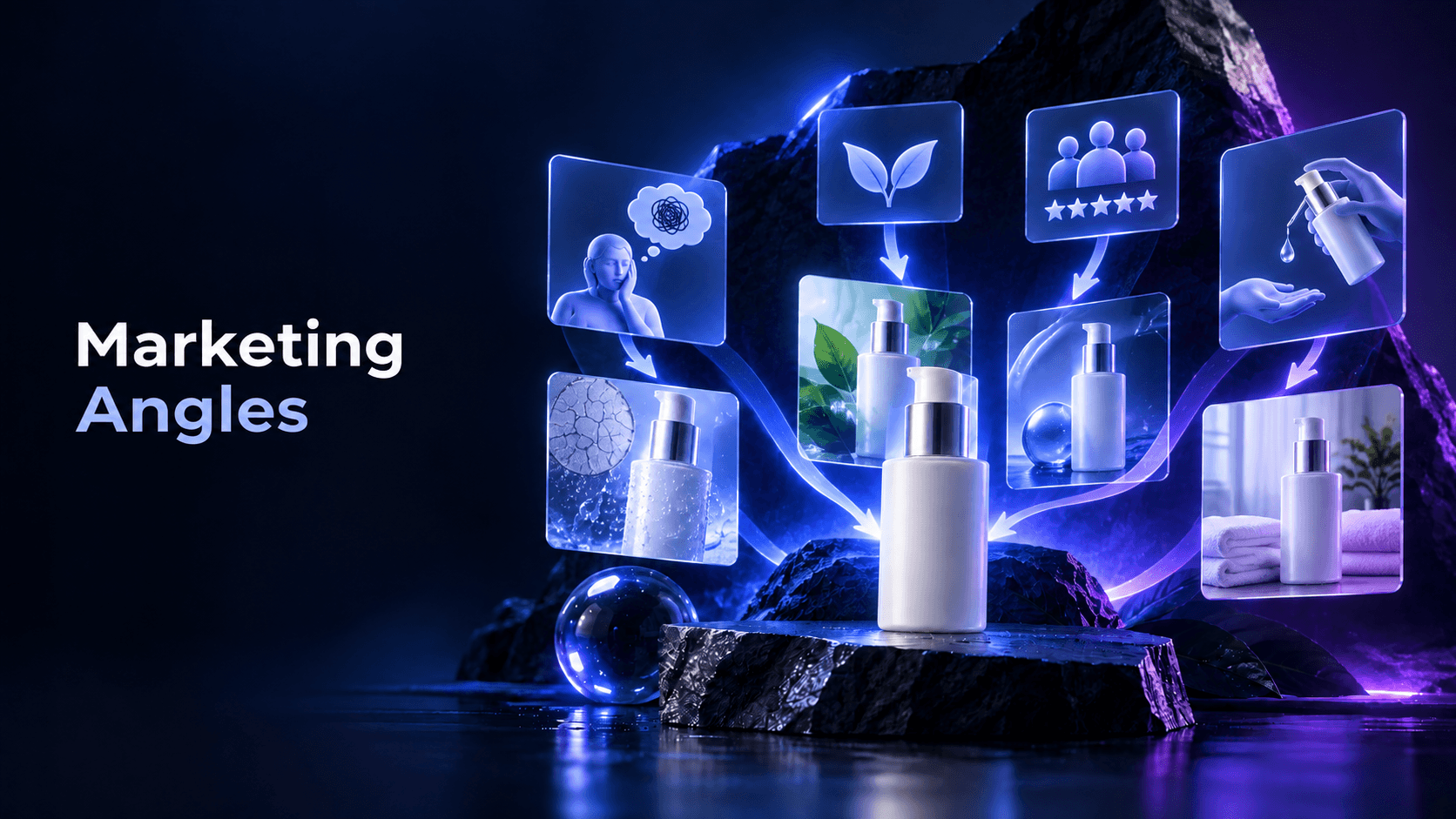
A marketing angle is the strategic point of view that makes a product relevant to a particular customer situation. It might be built around a problem, a desired outcome, an objection, a use case, a product difference, or a piece of proof.
An angle is not the same thing as a catchy opening line. The opening is the hook. The angle is the underlying idea that gives the hook somewhere useful to go.
That distinction matters for ecommerce teams. When every ad starts with a new headline but says essentially the same thing, production increases without creating much new learning. When each creative direction is based on a different customer truth or product story, the team can make more intentional variations and review them more clearly.
This guide explains how to find marketing angles, how to separate an angle from a message or format, and how to turn one product into several useful ecommerce ad directions. The examples are fictional unless a source is named, and no angle can guarantee ad performance.
A marketing angle is the reason a product is worth considering from one specific point of view. It answers a question such as:
For a reusable water bottle, “stay hydrated” is a broad benefit. A more useful angle might be “make carrying water through a busy commute less awkward.” That angle suggests a customer context, a product demonstration, and a type of message. It could lead to a short video showing a bottle moving from a train platform to a desk, or a static creative focused on leak-resistant closure and bag fit—provided those details are true for the product.
The angle is therefore a creative direction, not a promise. It helps the team decide what to show, say, and verify.
These terms are related, but they do different jobs:
Consider a fictional skincare product with a pump bottle.
The same angle could use another hook, such as “The step I stopped skipping at night.” It could also use a static product-and-routine image. The angle remains relatively stable while the expression changes.
TikTok for Business describes a similar separation between the hook, the key message, and the CTA: the opening earns attention, the middle communicates the product’s key idea, and the close encourages a next action. Its Creative Codes guide also frames a short ad through hook, body, and close. These are useful production structures, while the marketing angle sits one level above them as the reason for the story.
Products are often used in more than one situation, and buyers do not all arrive with the same question. A product page may list features, but an ad needs to choose which relevance to foreground.
Imagine a compact travel organizer. Possible angles include:
None of these is automatically the “best” angle. They are different hypotheses about why a particular person might care. Each one needs a truthful product detail and a suitable execution.
This is why a list of features is not the same as a list of angles. “Water-resistant fabric” is a feature. “Keep small essentials together when the weather changes” is a use-case angle that may be supported by that feature, if the product evidence allows the claim.
Use the following five-part worksheet before writing a script or designing an ad.
Write what the person is doing, deciding, or struggling with. Avoid starting with a demographic label such as “busy professionals.” A situation is more useful: “Someone is moving from a train platform to a desk with a bottle in a crowded work bag.”
Good situations contain a moment, a task, or a decision. They give the creative team something observable to show.
What feels difficult, uncertain, slow, inconvenient, or easy to overlook? What would the customer like to be different?
For a storage product, the tension might be “the item is useful, but it is hard to find in a packed drawer.” The desired change might be “see and reach the item without emptying the drawer.” Keep the statement concrete. Avoid turning it into an unsupported promise about productivity or lifestyle transformation.
Now select the angle family that best frames the situation. Is the creative about a problem, a use case, a benefit, a demonstration, an objection, a comparison, proof, or an occasion?
The point of view should narrow the story. If the direction still includes every product benefit, it is not specific enough yet.
Ask what the ad can show or verify. Proof might be a product action, a stated specification, a close-up, an approved review, a comparison with clear conditions, or a step-by-step demonstration.
Proof limits the claim. Showing one organizer fitting a drawer supports an observation about that drawer; it does not prove that every drawer will become organized. A customer quote can support only what the quote actually says and what the brand is permitted to use.
The CTA should follow the information the creative provides. A product introduction might lead to “See how it works.” A comparison might lead to “View sizes.” A ready-to-buy offer might lead to “Shop now.” The CTA is part of the direction because it determines what the viewer is prepared to do next.
These families are starting points, not a checklist that every product must use.
Start with a recognizable friction or question, then show how the product addresses it. This works best when the audience already recognizes the problem.
Example: “A crowded bathroom counter makes the morning routine harder to navigate.” The creative could show the product in that real context, then demonstrate the specific organization or access benefit it supports.
Frame the product around a moment, environment, or routine. The use case makes a general product more relevant to a particular buyer.
Example: a compact light described around late-night reading in a shared room rather than as a generic “portable light.”
Lead with a meaningful product benefit, but keep it tied to a verifiable feature or experience.
Example: “Make the cleaning step easier to understand” is more grounded than “never worry about maintenance again.”
Let the product action carry the story. This is useful when the mechanism, texture, setup, or transformation is easier to understand when seen.
Example: show how a clasp closes, how a container fits into a shelf, or how a product is used in the intended sequence.
Address a hesitation before the viewer has to ask it. Common objections concern size, setup, maintenance, compatibility, durability, or whether the product fits a routine.
Example: “Will this fit in a small travel bag?” The answer should use actual dimensions or a clearly labeled demonstration, not a vague claim of universal fit.
Help the viewer understand a choice between options. Comparisons need clear conditions: size, material, use case, included features, or another defined basis.
Example: compare two sizes by the type of load each is designed to hold. Do not imply that one option is better for everyone.
Center the creative on evidence such as a product detail, approved customer feedback, certification, or a visible result with carefully stated limits.
Example: zoom into the construction detail that a shopper wants to inspect before buying.
Connect the product to a recurring activity, season, event, or habit. This can make the product feel timely without relying on urgency that has not been substantiated.
Example: a giftable accessory framed around preparing for a first day of travel, with the product’s actual use and presentation visible.
Suppose an ecommerce brand sells a fictional insulated lunch container. The product information confirms its dimensions, closure design, material, and cleaning instructions. The team could form three directions:
Angle 1: the workday carry. The customer wants lunch to move from home to the office without taking over the bag. The message is about the stated size and closure. The hook could ask, “What fits in your work bag before lunch?” The format could be a bag-pack demonstration.
Angle 2: the portion decision. The customer is unsure which size suits their usual meal. The message is a clear comparison between the available sizes. The hook could open with two containers beside two example portions. The format could be a side-by-side comparison.
Angle 3: the cleaning question. The customer wants to know what happens after use. The message is a step-by-step look at the stated cleaning process. The hook could be, “The part of a lunch container I check before buying.” The format could be a close-up demonstration.
These directions use the same product, but each asks a different buyer question. They should not be collapsed into one crowded ad. The angle determines the message, the proof, the opening, and the most useful format.
Once the angle is chosen, create variations that keep its learning question visible. For the cleaning angle, you could vary:
You are still exploring the same strategic idea. If you change the angle, audience situation, product, and CTA at the same time, it becomes harder to know what the variation represents.
This is where marketing angles connect to a broader creative strategy and to a documented creative testing framework. The angle creates the hypothesis; the variation gives it an executable form; the review process records what the team learned. A creative brief template can capture the audience context, angle, proof, format, and CTA before production.
Before producing an ad, ask:
Sprokl can help ecommerce teams explore creative angles, hooks, scripts, and messaging frameworks from product assets and brand information, then turn those directions into multiple video-ad variations. The output still needs product, brand, and claims review before it becomes production creative. See the creative angles feature and the ecommerce ads use case to explore where that workflow fits.
The useful question is not “How many ideas can we produce?” It is “What different customer truths can we explain clearly, and what evidence can each creative show?” That is the role of a marketing angle.
Keep exploring


Make the next creative move
Build, test, and iterate on ecommerce ad creatives faster with AI-powered concepts, scripts, and variations.